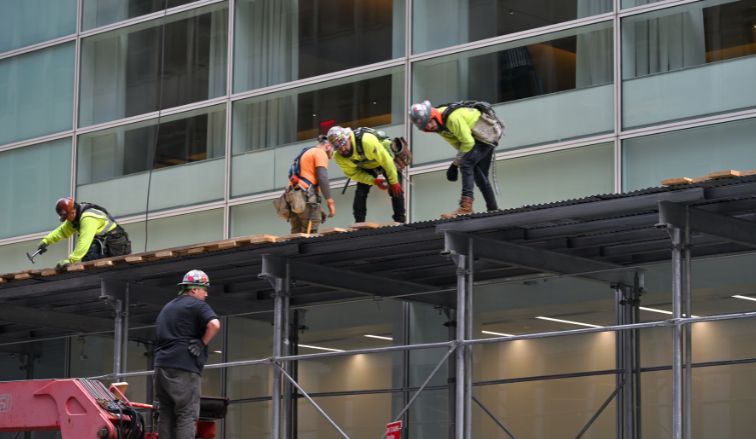
New York Harbor has been a working waterfront for centuries. Today, longshoremen, harbor workers, ship repairers, and marine construction workers keep billions of dollars’ worth of cargo moving through terminals in Brooklyn, Staten Island, and beyond, often in dangerous conditions, with heavy machinery, unpredictable weather, and the constant pressure of tight schedules.
When a dock worker is seriously injured, the path to compensation is governed not by New York’s workers’ compensation system, but by the Longshore and Harbor Workers’ Compensation Act, which has its own rules and processes. Navigating the LHWCA alone, while dealing with a serious injury, puts injured workers at a serious disadvantage against experienced insurance carriers who do this every day.
At Douglas & London, our injury lawyers represent injured maritime workers and their families across New York City. Contact us today for a free consultation.
What Is the Longshore and Harbor Workers’ Compensation Act?
The Longshore and Harbor Workers’ Compensation Act (LHWCA) is a federal workers’ compensation law enacted in 1927 and substantially amended in 1972.
It was created because the Supreme Court had ruled that states could not extend workers’ compensation coverage to maritime workers injured over navigable waters, leaving longshoremen and dock workers with no legal remedy for workplace injuries. The LHWCA filled that gap.
The LHWCA is a no-fault system: injured workers do not need to prove their employer was negligent to receive benefits. Such benefits include:
- Medical Benefits: Injured workers are entitled to full coverage of all reasonable and necessary medical treatment—emergency care, surgery, hospitalization, medications, physical therapy, prosthetics, and any other services or devices required for recovery.
- Disability Compensation: Disability benefits are calculated based on your average weekly wage and the nature of your disability—whether temporary or permanent, total or partial. In most cases, wage replacement comes to two-thirds of your pre-injury earnings. Lost future earning capacity can also be accounted for.
- Vocational Rehabilitation: If a permanent disability prevents you from returning to your prior job, the LHWCA provides vocational rehabilitation services, including skills testing, job counseling, training, and placement assistance.
- Death Benefits: If a worker dies as a result of a job-related injury, eligible dependents are entitled to death benefits based on the deceased worker’s average weekly wage, along with coverage for reasonable funeral and burial expenses.
Who Qualifies for LHWCA Coverage?
Coverage under the LHWCA hinges on two legal tests that must both be satisfied:
- The Situs Test requires that the injury occurred on, or in an area adjoining, the navigable waters of the United States. Covered locations include piers, wharves, docks, terminals, dry docks, marine railways, shipyards, and any area customarily used for loading, unloading, repairing, or building vessels. For New York workers, this includes the terminals and piers described above, as well as any similar waterfront facility in the five boroughs or along the harbor.
- The Status Test requires that the worker was engaged in maritime employment at the time of injury. This includes longshoremen, stevedores, ship repairers, shipbuilders, ship breakers, harbor construction workers, crane operators, equipment maintenance and repair workers, checkers, and other workers whose duties are integral to loading, unloading, building, or repairing vessels.
Workers who may not qualify include vessel crew members (who are covered by the Jones Act), federal and state government employees, and workers whose jobs are purely clerical, administrative, data processing, or security-related.
If you are unsure whether you qualify, an experienced maritime attorney at Douglas & London can help you determine which legal framework applies to your situation.
We Are Available for You 24/7.
Call 646-594-1112 for a Free Consultation
Common Causes of Longshore and Harbor Worker Injuries in New York
The work performed at New York’s terminals and waterfront facilities is physically demanding, often involving heavy machinery, significant elevation changes, and constant exposure to moving cargo and vessels. Common causes of injury include:
- Crane accidents, including falls from cranes, being struck by crane components or suspended loads, and equipment malfunctions
- Struck-by accidents, where workers are hit by swinging cargo, containers, or machinery such as reach stackers, forklifts, and hustler trucks
- Falls from piers, docks, gangways, vessel holds, or elevated work surfaces
- Caught-in or caught-between accidents involving machinery, vessel hatches, or rigging equipment
- Slips and falls on wet, oily, or cluttered dock surfaces
- Exposure to hazardous materials, including chemicals, asbestos in older vessels, and toxic cargo
- Overexertion and repetitive stress injuries from the physical demands of cargo handling
- Vessel-related accidents during the loading, unloading, or repair process
- Equipment failures resulting from inadequate maintenance or defective gear
Third-Party Claims Under Section 905(b)
The LHWCA’s no-fault benefit system is not always the only avenue for recovery. Under Section 905(b) of the Act, an injured longshore or harbor worker may also be able to bring a negligence lawsuit directly against a vessel owner—separate from and in addition to their LHWCA benefits claim.
Vessel owners owe longshore workers three duties: the turnover duty (delivering a vessel in a reasonably safe condition), the active control duty (exercising reasonable care in areas under the vessel owner’s active control during operations), and the duty to intervene (correcting hazards).
When a vessel owner breaches any of these duties, a successful 905(b) claim can result in additional compensation beyond what the LHWCA provides, including damages for pain and suffering.
This is one of the most valuable and underutilized rights available to injured New York maritime workers, and it requires an attorney who knows how to fight for them.
LHWCA Deadlines: Don’t Wait
The LHWCA imposes strict procedural deadlines that injured workers must follow:
- Notice to Employer: You must notify your employer of your injury in writing within 30 days of the accident, or within 30 days of learning that your illness or condition is work-related. Use OWCP Form LS-201. Failure to provide notice on time can jeopardize your claim.
- Filing a Claim: You must file a formal claim with the U.S. Department of Labor’s District Office within one year of the date of injury or the date of your last compensation payment. In cases of occupational disease or gradual-onset injuries, the deadline runs from the date you knew or should have known of the relationship between your work and your condition.
- Death Benefit Claims: Surviving family members must file within one year of the worker’s death.
Evidence deteriorates quickly: surveillance footage from terminal cameras is routinely overwritten, and equipment maintenance records and inspection logs may be difficult to obtain later. The sooner you contact Douglas & London after an injury, the better positioned we will be to preserve the evidence that supports your claim.
Common Sites of Longshore and Harbor Worker Injuries in NYC
The Port of New York and New Jersey is the largest container port on the East Coast and the third largest in the United States. It encompasses major marine terminals on both sides of the Hudson, including facilities that are part of everyday life for thousands of workers represented by the International Longshoremen’s Association (ILA) and related unions.
Some New York-side facilities where longshore and harbor workers are commonly employed include:
- Red Hook Container Terminal: This facility handles container ships and bulk cargo along 2,080 feet of berth space on Upper New York Bay. Workers here—primarily members of ILA Local 1814—handle gantry cranes, hustler trucks, reach stackers, and breakbulk cargo.
- Brooklyn Marine Terminal: This 122-acre stretch of Brooklyn waterfront, running from Atlantic Basin south, continues to serve as an active maritime and industrial hub undergoing significant redevelopment.
- Howland Hook Marine Terminal: Located at the entrance to Newark Bay in northwestern Staten Island, Howland Hook, operating as Port Liberty New York, is a 311-acre facility with hundreds of ILA union positions.
- Brooklyn Navy Yard: Though best known for industrial and manufacturing tenants today, the Navy Yard continues to host maritime repair and construction work that may fall under LHWCA coverage.
- Other piers, wharves, and marine facilities throughout New York City’s extensive waterfront, including facilities along the East River and the Kill Van Kull.
Contact Douglas & London Today
If you were injured working on the docks, terminals, piers, or waterfront facilities of New York City, you have federal rights, and you deserve an attorney who knows how to protect them. The LHWCA is a powerful but complex law, and the insurance companies defending against your claim are not on your side.
Contact Douglas & London today for a free, confidential consultation. You work hard. Now let us do the same for you and your family.